AI vs. Traditional Video Production: Which Approach Suits Your Brand?
In today’s digital-first world, video is king. From Instagram Reels to YouTube ads and corporate training modules, video content drives engagement, builds trust, and boosts conversions. In India, video consumption has exploded, with over 500 million internet users actively watching content daily. But as brands scramble to keep up, a critical question arises: Should you invest in AI video production or stick with traditional methods?
This guide breaks down both approaches, their pros and cons, and helps you decide which (or a blend of both) is best for your Indian brand.
Why Video Marketing Matters in India (2024 & Beyond)
India’s digital landscape is unique. With diverse languages, regional cultures, and a young, tech-savvy population, video is the most effective way to connect. Platforms like WhatsApp, YouTube, Instagram, and TikTok dominate, and consumers increasingly prefer short, snappy, and authentic video content.
However, producing high-quality videos can be time-consuming and expensive. Enter AI video production – a game-changer that’s democratizing video creation. But is it truly a replacement for traditional methods? Let’s find out.
What is AI Video Production?
AI video production uses artificial intelligence tools to automate or enhance parts of the video creation process. Instead of cameras, actors, and editing suites, AI leverages algorithms to generate visuals, voices, and animations from text, images, or templates.
Popular AI Tools:
Synthesia: Create professional videos with AI avatars speaking in 120+ languages – perfect for training or explainer videos.
Runway ML: Edit videos, remove backgrounds, or generate new scenes using text prompts (e.g., “a Mumbai street during monsoon”).
OpenAI (Sora, DALL-E): Generate video clips or storyboards from text descriptions.
InVideo, Pictory, HeyGen: Template-based platforms for quick social media ads, testimonials, or promotional content.
How It Works:
Input your script or upload assets (images, logos).
AI generates scenes, adds voiceovers (synthetic or cloned voices), and syncs animations.
Customize templates, add music, and export.
Time: Often under 1 hour for a 1-minute video.
What is Traditional Video Production?
Traditional video production follows a collaborative, hands-on process involving pre-production, shooting, and post-production. It’s the “classic” method used for films, ad campaigns, and high-end brand videos.
The Creative Process:
Pre-Production:
Scriptwriting & Storyboarding
Location Scouting (e.g., finding a café in Bangalore or a farm in Punjab)
Casting (actors/models)
Crew hiring (director, cinematographer, sound engineer)
Production:
Filming with cameras, lights, and microphones.
Directing actors and setting up shots.
Post-Production:
Editing footage
Color grading, VFX, sound design
Final review and rendering
This method is labour-intensive but offers unparalleled creative control.
Pros and Cons: AI vs. Traditional Video Production
Advantages of AI Video Production
Cost-Effective:
No need for actors, crew, or location permits. Most tools offer subscription plans starting at ₹500–₹2,000/month.Speed:
Generate a video in minutes or hours, not days/weeks. Ideal for agile marketing.Scalability:
Produce 100s of personalized videos (e.g., for different regions: Hindi, Tamil, Bengali) simultaneously.Accessibility:
No technical skills needed. User-friendly interfaces empower SMEs and startups.Multilingual Capabilities:
Easily localize content for India’s diverse languages without re-shooting.
Disadvantages of AI Video Production
Limited Emotional Depth:
AI avatars can feel robotic. Hard to replicate human emotions for heartfelt brand stories.Creativity Constraints:
AI works within templates. Truly innovative visuals (e.g., complex metaphors) are challenging.Quality Concerns:
Lip-syncing issues, unnatural movements, or “uncanny valley” effect can harm brand perception.Ethical Risks:
Deepfakes and misinformation are growing concerns in India. Transparency is key.
Advantages of Traditional Video Production
Authenticity & Emotional Impact:
Real actors, real locati genuine connections. Perfect for brand films or emotional ads (e.g., Tata, Airtel).High Creative Freedom:
Experiment with angles, lighting, and storytelling. No algorithmic limitations.Superior Visual Quality:
Cinematic 4K/8K footage with rich textures and depth.Brand Control:
Full oversight over every detail ensures brand consistency.
Disadvantages of Traditional Video Production
High Cost:
A 2-minute ad can cost ₹2–₹20+ lakhs (equipment, crew, location, editing).Time-Consuming:
4–8 weeks from concept to final cut.Logistical Challenges:
Coordinating schedules, permits (especially in metro cities), and travel.Limited Scalability:
Customizing for multiple regions requires separate shoots.
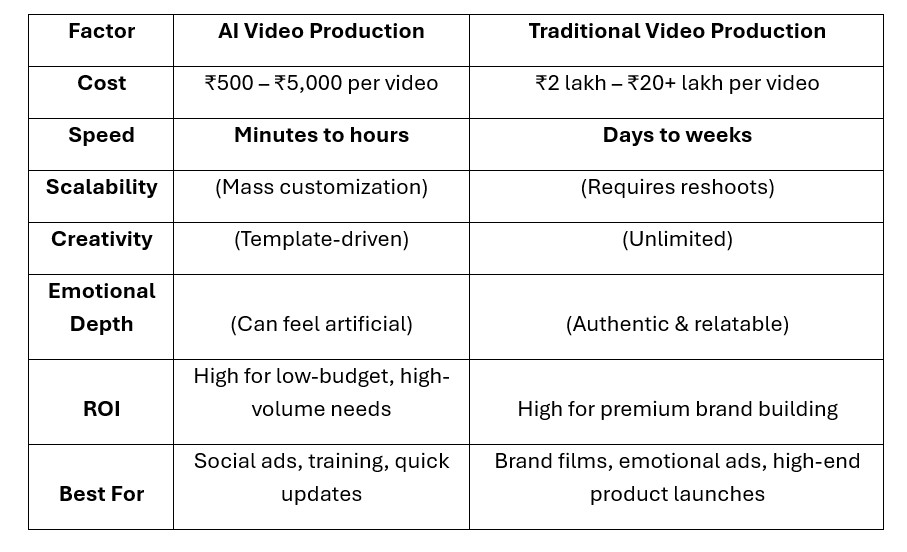
AI vs. Traditional Video Production: Comparison Table
When Should Your Brand Choose AI, Traditional, or Hybrid?
Choose AI Video Production If:
You need quick, low-cost videos (e.g., Instagram Reels, YouTube Shorts).
You’re creating training/induction videos for employees.
You want personalized bulk videos (e.g., “Hi [Customer Name], here’s your offer!”).
Your budget is limited (startups/SMEs).
Content is informative, not emotional (e.g., “How to use Product X”).
Ideal For: E-commerce stores, ed-tech startups, SMEs, social media managers.
Choose Traditional Video Production If:
You’re launching a high-value product (e.g., luxury watch, real estate).
You want to evoke strong emotions (e.g., a Diwali ad, a heartwarming story).
Brand image is critical (e.g., banks, automobiles, FMCG giants like HUL or ITC).
You have a generous budget and timeline.
Ideal For: Established brands, TV commercials, brand films, premium events.
Choose a Hybrid Approach:
This is fast becoming the gold standard in India. Combine both worlds:
Use AI for scripting, storyboarding, or simple animations.
Film key scenes traditionally (e.g., a CEO interview or emotional moment).
Add AI voiceovers or subtitles for multilingual reach.
Example:
A bank uses AI to generate 90% of its training modules but films a 30-second intro with real employees to build trust.
Future Trends in Video Marketing (2026 & Beyond)
The line between AI and traditional video will blur. Here’s what to expect:
Hyper-Personalization:
AI will enable real-time personalized videos (e.g., “Rahul, this offer is curated for you!”) at scale.Interactive & Shoppable Videos:
Clickable videos where users can purchase products directly (e.g., “Tap to buy this saree”).AI-Powered Analytics:
Tools will predict engagement metrics before publishing, optimizing content dynamically.AR/VR Integration:
Combine AI video with augmented reality (e.g., “See how this sofa looks in your living room”).Ethical AI Regulations:
India’s government will likely introduce strict guidelines for deepfakes and AI transparency.Regional AI Avatars:
AI tools will improve lip-sync and expressions for regional languages, making them more natural.
Conclusion: Make the Right Choice for Your Brand
There’s no one-size-fits-all answer. AI video production is revolutionizing speed and accessibility, especially for budget-conscious, high-volume needs. Traditional video production remains unmatched for building emotional connections and premium brand perception.
Your Zeros and Ones
Sharing insights on web development, design, and technology.